On Sunday, 20 December 2026, the Advent town of Annaberg-Buchholz takes on a different rhythm. At 1.30pm, the grand miners’ parade sets off; at its conclusion, the mining bands gather in front of St Anne’s Church. The organisers expect more than 1,000 participants in traditional dress from Saxony and other German mining regions. For visitors, it is an impressive urban spectacle. For the people in the associations, it means far more than a public appearance: a shared understanding of origins, craftsmanship and belonging.
A Habit tells a story of work and origins
Traditional miners’ dress, often called Habit in the Ore Mountains, is no arbitrary festive attire. Its cut, colours and accessories indicate a mining district, historical period and role within mining. The German Commission for UNESCO describes the Habit as part of a living tradition in which its upkeep and wearing are passed down. Anyone watching several groups in a parade therefore encounters different regional traditions – marching in orderly step, but not in a single uniform.
The miners’ parades recall a working world that shaped the towns and landscapes of the Ore Mountains for centuries. Mining here meant more than work underground: it shaped social structures, associations and musical traditions. Miners’ processions have been documented since the 17th century. They were held on various occasions, for example to honour the authorities or to give visibility to the interests of miners’ guilds. Today’s parade carries this history forward without simply re-enacting it: women and children now take part too, and the bands play newer marches alongside traditional ones.
Belonging takes shape in associations
A Habit does not become cultural heritage through its appearance alone. That also requires people who preserve, care for and wear it, as well as associations that pass on knowledge and musical practice. Saxony’s miners’ parades and processions have been listed in Germany’s Nationwide Inventory of Intangible Cultural Heritage since 2016. This recognition honours a living practice – not merely historical clothing or a stage set.
Marching in step makes the group visible; the individual Habits also preserve distinctions. Behind every association’s public appearance lie shared responsibilities: uniform items are maintained, appearances prepared and marches rehearsed. Such tasks connect generations and create a form of regional belonging that need not depend on ancestry. Visitors to the parade see this work on the streets for just a moment. It begins long before Advent and extends beyond the day of celebration.
A Sunday for the whole old town
The town and the Annaberger Weihnachtsmarkt announce a 1.30pm start. The procession follows Wolkensteiner Straße to the market square, continues along Buchholzer Straße and back, then takes Große Kirchgasse to St Anne’s Church. The closing ceremony with the mining bands is scheduled to take place there. In 2026, the Christmas market runs from 27 November to 23 December; for parade visitors, the Advent bustle is concentrated particularly on the fourth Sunday.
The parade offers a reason to see the town as more than market stalls and photo opportunities. The route through the old town passes buildings that form part of this mining town’s history; St Anne’s Church provides the striking endpoint for the ceremony. Anyone wishing to take the day at a gentler pace can visit the market at a different time from the procession and follow the organisers’ route guidance. With large crowds, unobstructed viewing spots are scarce; access points and emergency routes must be kept clear.
Planning travel by train and bus
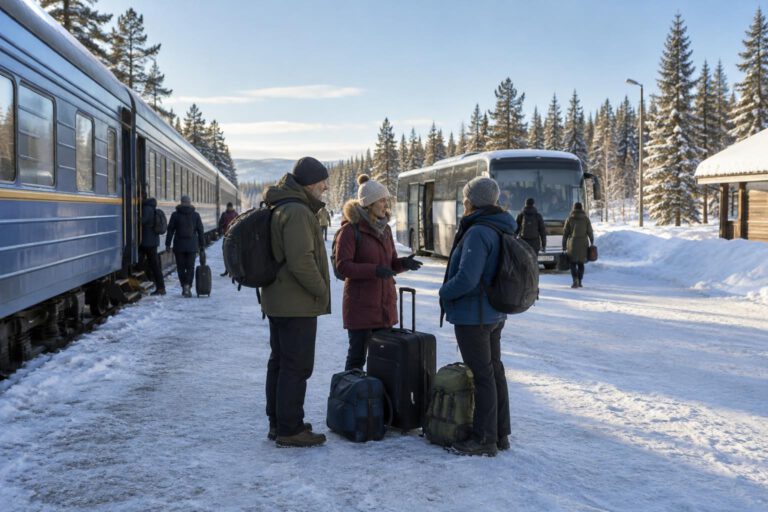
Annaberg-Buchholz can be reached on the Erzgebirgsbahn’s RB 80 line from the directions of Chemnitz and Cranzahl. Train travel can be combined with scheduled bus services from several places in the region; the town’s Christmas market information lists connections to the bus station from Aue, Chemnitz, Marienberg, Schwarzenberg, Stollberg and Oberwiesenthal, among others. For the Sunday of the miners’ parade, travellers should check their specific connection, including the return journey, using up-to-date timetable information: engineering works and special arrangements may alter timings. The event details in this article are current as of 20 November 2026; last-minute changes are possible.
Seen in this light, the parade is both an Advent event for visitors and a public expression of regional remembrance. Its true continuity is evident not only in the synchronised marching. It thrives because people keep taking on the traditional dress and its meanings – and giving them a place in the present.
Original reviewed by the editors · 20 November 2026