When Schwibbögen (decorative candle arches) glow in windows during Advent, they reveal a story in the Ore Mountains that began long before the Christmas decorations. It is a story of ore, hard work underground and how people turned their skills to new occupations. Mining, crafts and customs are closely intertwined here – a relationship that continues to shape this cultural landscape.
On 28 and 29 November 2026, the Weißeritztalbahn offers an opportunity to explore this history in the Eastern Ore Mountains: during “Bimmelbahn & Lichterglanz”, stations from Freital-Hainsberg to Kurort Kipsdorf are linked by Advent activities. The journey through several towns and villages offers a way into the region, rather than telling the whole story of the World Heritage Site.
A landscape shaped by ore
The Erzgebirge/Krušnohoří Mining Region is a cross-border cultural landscape in Saxony and Czechia. Ore was extracted here for centuries, beginning in the Middle Ages. Its heritage encompasses mines and shafts as well as mining towns, water management systems, transport routes, spoil heaps and forests. The German Commission for UNESCO describes the region as an interconnected whole that developed over a long period, in which mining and the activities supporting it shaped the landscape and people’s lives.
Silver discoveries made the Ore Mountains an important European mining area at various times. Towns grew up alongside the mines, as did rules governing work and administration. Mining was therefore more than an industry: it determined social structures, knowledge and everyday life. When miners parade through the towns in historical uniforms today, they evoke this organised world of work. Miners’ parades and processions have been included in Germany’s Nationwide Inventory of Intangible Cultural Heritage since 2016.
When mining enters the home
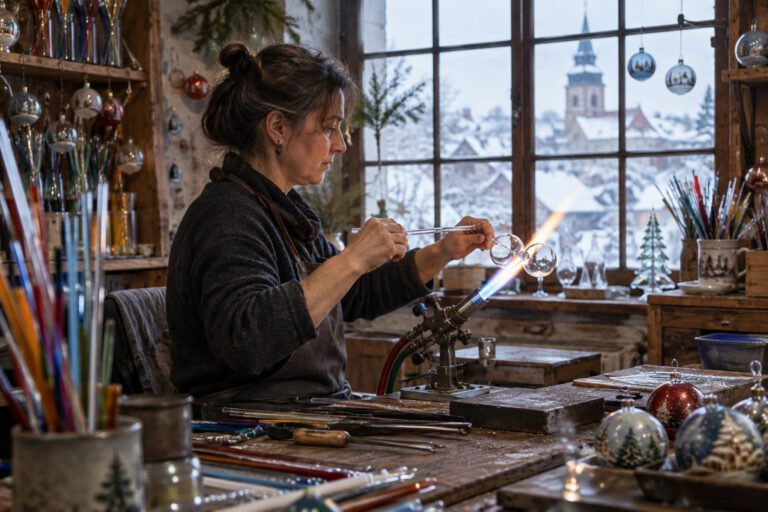
The folk art of the Ore Mountains also bears traces of this history. As mining declined in importance in some places, people used their craft skills to develop new sources of income. Wood was carved, turned and painted; among the objects that emerged were nutcrackers, Räuchermännchen (incense smoker figures), Christmas pyramids and Schwibbögen. These crafts transformed mining motifs into objects for the home and products that could be sold.
The Schwibbogen is this tradition’s most distinctive symbol of light. Its shape is often associated with a mine entrance and the last shift before Christmas, known as the Mettenschicht. This interpretation explains why light is so prominent in Christmas decorations from the Ore Mountains; it should be understood as a traditional explanation, rather than a proven account of their origins. Figures of miners and angels extend the connection between work, faith and celebration. These motifs are not merely reminders of a bygone era: workshops and family businesses keep the techniques and designs alive.
A railway as a gateway to the cultural landscape
On the first weekend of Advent, “Bimmelbahn & Lichterglanz” links a series of themed stations along the Weißeritztalbahn. The organisers list Freital-Hainsberg, Rabenau, Malter, Dippoldiswalde, Obercarsdorf, Schmiedeberg and Kurort Kipsdorf as stops. The narrow-gauge railway connects the towns and villages, while the activities at each station provide their own reasons to get off. This suits a trip focused on one or a few places, rather than ticking off as many markets as possible in a short time.
For travel to the railway, the operator points to train and S-Bahn connections to Freital-Hainsberg from Dresden and Chemnitz. A special timetable has been announced for the event; journey times and the programme may change and should be checked before travelling. Those wishing to explore the mining history in greater depth can combine their visit with one of the World Heritage locations: the UNESCO site comprises many separate components and does not follow the same boundaries as the railway route.
The Advent decorations thus tell a story of change: a region whose prosperity and everyday life depended on mining for centuries gave rise to crafts that continue to provide work and a sense of identity. The light in the window evokes the darkness of the mine – and, at the same time, the ability to create something new from inherited knowledge.
Original reviewed by the editors · 11 November 2026