During the winter months, geese, ducks and other waterbirds stay on Schleswig-Holstein’s North Sea coast. Their presence makes the quiet season a good time for wildlife watching – and shows how closely visitors’ experiences are linked to protecting the birds’ resting sites. For the birds, the Wadden Sea is above all a place where they must be able to find food and rest undisturbed.
A resting place on an international migration route
During the winter months, brent, barnacle, white-fronted and greylag geese are among the birds that can be seen in the national park. Eiders and wigeon also spend the winter on the coast. Snow buntings, twite and shore larks search for seeds along strandlines and in salt marshes, as the national park authority describes. Which species can actually be seen depends on the location, weather and timing.
The Wadden Sea forms part of an extensive network of migration routes between Arctic breeding grounds and wintering areas. Millions of birds stop here in autumn and spring; some species make only a few stops on their long journeys. They use tidal flats, salt marshes and adjoining marshland to feed and rest. Food from the tidal flats helps them build up energy reserves for the onward flight.
The same principle applies in winter: a good place to watch birds is one where they are not startled into flight. Taking flight costs energy, and repeated disturbance can reduce the value of resting and feeding sites. The national park authority recommends staying on waymarked paths and following the code of conduct for nature-friendly birdwatching. Binoculars allow you to watch from a distance; moving closer rarely achieves anything beyond disturbance.
A protected area facing competing demands
The Schleswig-Holstein Wadden Sea National Park was established in 1985. The Wadden Sea has been a UNESCO World Heritage Site since 2009; today, the transboundary site encompasses areas in the Netherlands, Germany and Denmark. The UNESCO Commission identifies tourism, economic use and climate change as changes that require ongoing attention. Protection rules determine where human activities may take place and aim to preserve natural processes.
This is not just about individual rare animals. The Wadden Sea is a shifting mosaic of tidal flats, tidal creeks, salt marshes and islands. The tides transport sediment and continually reshape the coast. If sea levels rise faster than deposits can build up the tidal flats, their area may shrink. The state of Schleswig-Holstein describes this development as a challenge for nature conservation and coastal protection; its scale and timing remain uncertain. A fixed coastline, intensive use and the desire to preserve natural dynamics all meet here.
Tourism is part of this tension: visitors bring demand to the region and seek experiences in nature, while sensitive resting sites need peace and quiet. Visitor management – through designated paths, information and guided activities, for example – can concentrate visits in more resilient areas. It is no substitute for protection, but it makes clear that access and consideration for nature must be planned together.
Arrive, understand, observe
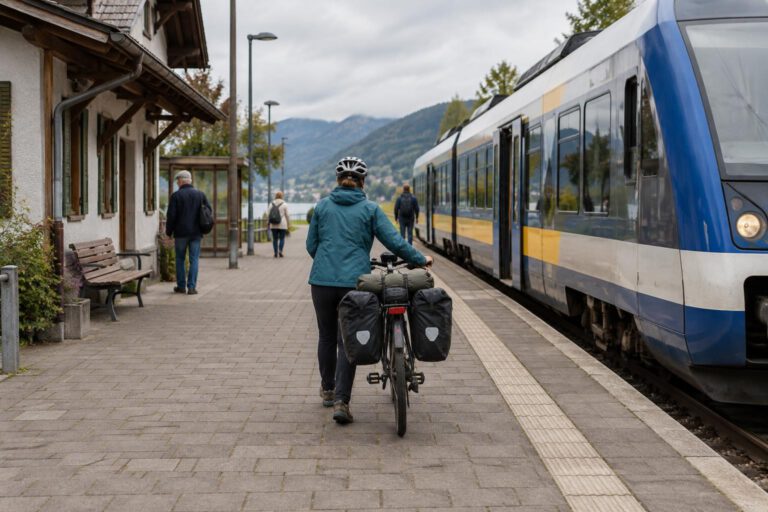
Husum is one possible starting point for a car-free trip. The Nationalpark-Haus by the harbour provides information about the protected area and its birds; it offers exhibitions, excursions and guided tidal-flat walks in the Husum area. In Tönning, the Multimar Wattforum explores habitats ranging from rivers and salt marshes to the tidal-flat floor and the North Sea through an interactive exhibition. The RB 64 railway line connects Husum, Tönning and Bad St. Peter-Ording. The published 2025/2026 timetable is valid until 12 December 2026; services after that date should be checked again before travelling.
Expert-led birdwatching tours are available from national park rangers and other providers. Dates depend on the season and location; some drop-in ranger activities end as early as autumn, while Schutzstation Wattenmeer offers guided tours all year round. For a winter visit, it is worth confirming a specific activity in advance. The same applies to exhibitions and opening hours.
Winter on the west coast rewards patience rather than proximity. Those who stay on designated paths, watch birds through binoculars and follow an expert guide can experience this landscape of resting birds without turning it into the setting for a pursuit. Keeping your distance does not mean missing out on nature; it is what allows nature to retain its own rhythm.
Original reviewed by the editors · 11 November 2026