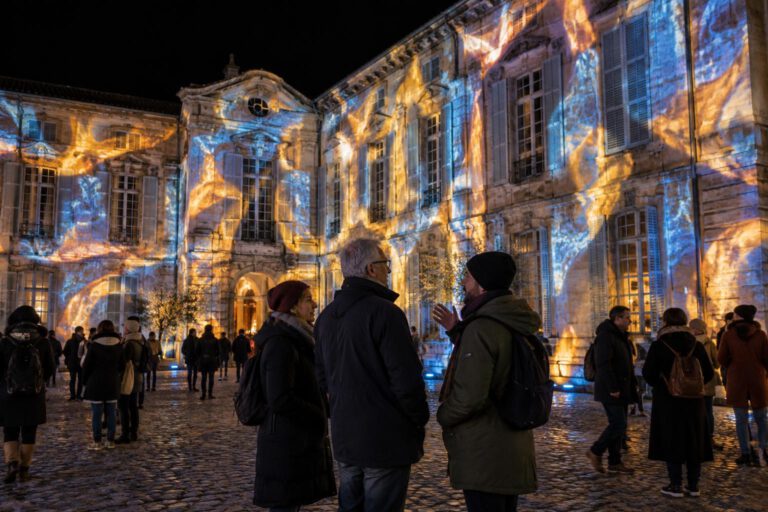
In December, light in Lyon changes not only what we see, but also what we notice. A façade that forms part of the familiar streetscape by day becomes a projection surface at night; a square becomes a place for watching together. From 5 to 8 December 2026, the Fête des Lumières will present 27 works in squares and at prominent locations, according to the city. Admission is free, and the evening programme usually runs from 7pm to 11pm, and from 6pm to 10pm on Sunday.
The shift between everyday life and festival is the key to Lyon’s history of light. The Fête offers a fresh perspective on the city – while also revealing how much that perspective is shaped by art, architecture and the routes we take.
From candles in windows to a city-wide event
8 December connects religious remembrance with contemporary city life. In 1852, a gilded statue of the Virgin Mary on Fourvière was due to be inaugurated on that date. After a postponement because of flooding, bad weather threatened to prevent the celebrations on the rescheduled date too. When the skies cleared, the people of Lyon placed candles in their windows. This spontaneous gesture grew into a tradition.
The event in its current form is much younger. In 1989, Lyon launched a “Plan Lumière”, making deliberate use of lighting to illuminate important buildings. In 1999, the single day of commemoration became a festival lasting several days, featuring artistic installations. This transformation shows how lighting evolved from a means of orientation and presentation into an art form in its own right. Light art does more than decorate the city: it frames selected views, creates contrasts and directs the eye towards particular details.
Façades as canvases, squares as meeting places
The 2026 programme includes Saint-Jean Cathedral in Vieux Lyon, Place des Terreaux, Place des Jacobins and Place Sathonay. On the Presqu’île, visitors’ routes and everyday errands intersect with grand squares; at the foot of the slopes leading up to Croix-Rousse, Place Sathonay offers a different, more intimate scale. Projections and installations change the impression these places make for a few hours. The stones and buildings remain the same, but their outlines emerge differently.
Video mapping – moving images projected onto uneven surfaces and building forms – makes architecture part of the work. Rows of windows, arches and the articulation of façades can shape the visual effect. At the same time, it is easy to lose sight of what defines a place’s function by day: routes to work, shops, residential buildings and squares that are still needed once the show is over. This is precisely why it is worth seeing the festival locations not merely as backdrops, but also considering their place in the urban fabric.
Four evenings, a different urban rhythm
During festival hours, the city centre becomes a vast pedestrian area for the public. According to the organiser, the central zone is closed to traffic from 5pm on the three evenings of 5, 7 and 8 December, and from 4pm on Sunday; bicycles and e-scooters may not be ridden there. The routes between installations are therefore as much a part of the festival as the works themselves. Getting there and moving between locations takes longer than on an ordinary evening.
The city recommends using public transport to reach the festival. The organiser also warns that Vieux Lyon metro station will be particularly busy and suggests Bellecour as an alternative. Such advice reveals the tension inherent in a festival that is both open to everyone and concentrated in particular parts of the city centre: large numbers of people temporarily share the same streets and squares, while local residents go about their daily lives there.
By day, these places can once again be read through their everyday rhythms. What the night-time projections can outshine then becomes apparent: the connections between neighbourhoods, the use of a square and architecture as part of an inhabited cityscape. To view Lyon in two different lights is to hold both together – the temporary art event and the city that carries on afterwards.
Original reviewed by the editors · 21 November 2026