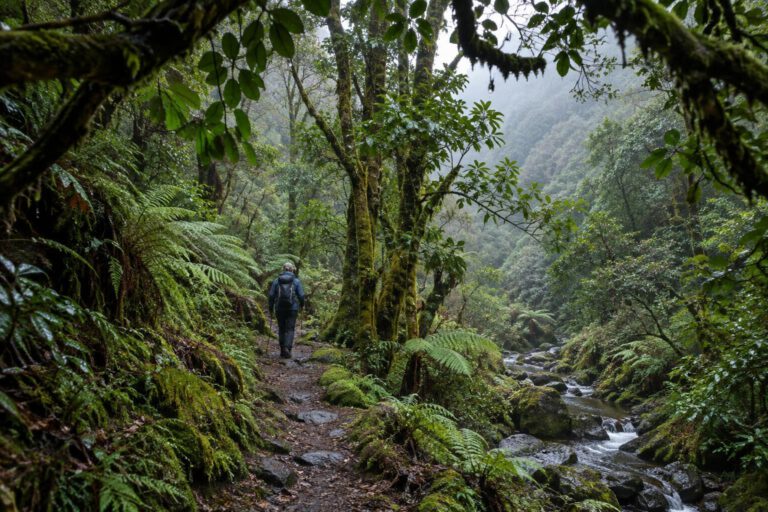
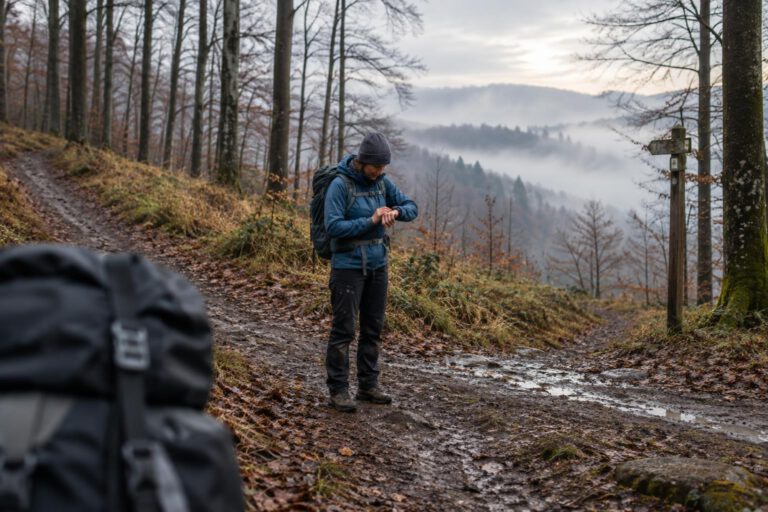
It is easy to think of La Gomera only in terms of its steep trails. Yet in the island’s interior lies Garajonay, a forest area where short walks can make a shared outing possible even for groups with different walking abilities. The tourist information specifically mentions adapted routes. This is a useful starting point for planning, but not a blanket statement about accessibility.
The national park was established in 1981 and has been a UNESCO World Heritage Site since 1986. Its laurisilva is an evergreen forest shaped by moisture-laden trade-wind clouds, in a landscape markedly different from the drier coasts. Garajonay is also a cultural landscape: the old paths in the park once connected the island’s settlements. Today, alongside forest conservation, they offer opportunities for low-impact exploration.
Short trails, specific questions
La Gomera’s tourism organisation lists Los Barranquillos as a circular route near Piedra Hincada: 0.8 kilometres, an easy difficulty rating and a walking time of around 20 minutes. A trail described as accessible also leads from the Contadero car park to Alto de Garajonay. This route is listed as 2.5 kilometres long, with a moderate difficulty rating and a walking time of around 60 minutes. These details are route descriptions, not a guarantee of current conditions or of trails suitable for every mobility aid.
The organisation lists Cañada de Jorge, Jardín de las Creces and the approach to the Ermita (chapel) near Chorros de Epina as further adapted trails with an easy rating. Choosing a route involves more than its length: the surface, gradient, width, potential narrow sections and the route from the car park or bus stop to the trailhead can all be decisive. These details need to be checked in advance for the specific route. Within the national park, visitors must keep to designated paths and follow visitor rules; these protect sensitive habitats and help ensure reliable use of the routes.
Forest rather than summit ambitions
For a group with mixed abilities, the appeal lies in being able to choose between a short circuit and a longer outing, without everyone having to meet the same demands. Anyone who does not want to walk, or cannot, still needs a suitable place to spend time and a reliable way of getting there. General trail information does not indicate whether bus stops, transfers and vehicles are suitable for individual mobility needs. Garajonay is therefore particularly well suited to groups that agree on both the route and travel arrangements in advance. Anyone who depends on continuously step-free paths, guaranteed transfers or destinations that can be reached at short notice should have these points specifically confirmed.
The island can be reached by ferry from Los Cristianos on Tenerife to San Sebastián de La Gomera; Fred. Olsen Express gives a crossing time of around 50 minutes. GuaguaGomera lists services between the six municipalities. Connections and bus frequencies for the national park itself need to be checked separately; anyone wishing to visit several forest locations in one day should not take transport for granted. In winter, La Gomera is an attractive choice for those seeking mild island regions and forest landscapes. The climate varies with the side of the island and the altitude; Garajonay can be wetter and cooler than the south coast.
At a glance
- Best time to visit: according to the tourism organisation, La Gomera can be visited year-round; the north and higher ground are generally cooler and wetter than the south.
- Getting there: ferry from Los Cristianos to San Sebastián de La Gomera; on the island, guaguas (buses) run between the six municipalities. There are no rail services on La Gomera.
- Highlights: laurisilva forest in Garajonay National Park; short trails described in tourist information as adapted near Piedra Hincada, Contadero and other locations.
- Tip for a day out: consider Los Barranquillos for a short circuit and confirm trail conditions and travel arrangements for the group in advance.
- Further information: La Gomera’s official tourism organisation and GuaguaGomera.
Original reviewed by the editors · 11 November 2026