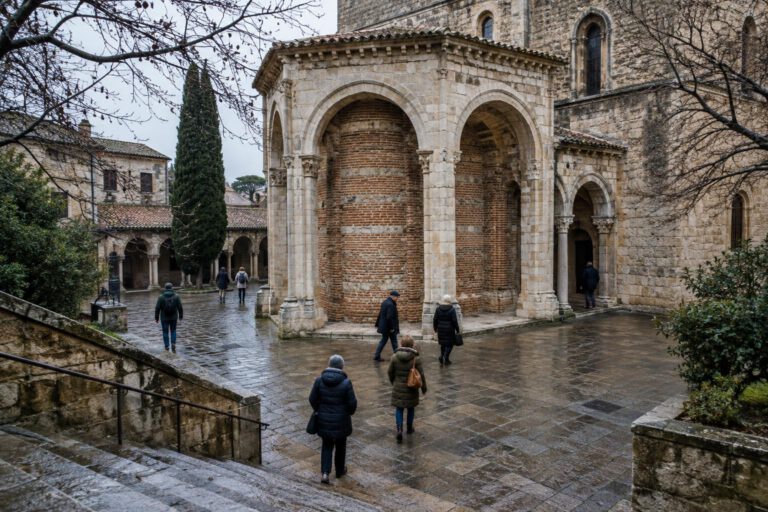
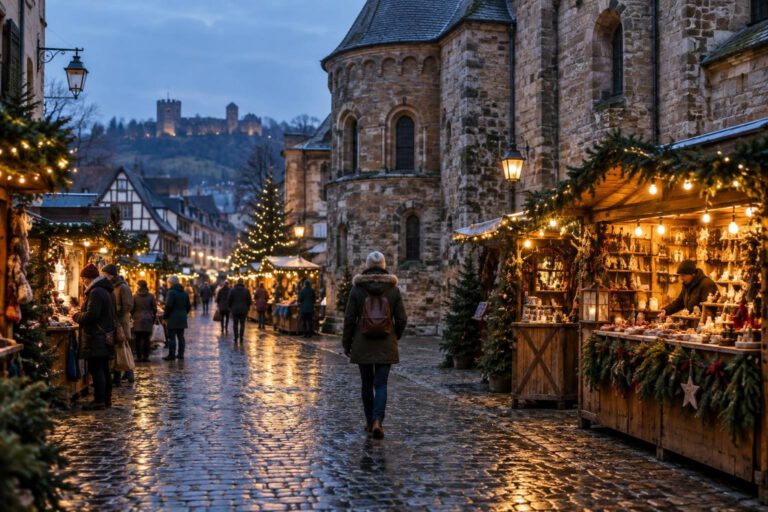
Trier can be read as a city of transitions. On the Moselle, the routes through the present-day city meet Roman walls, centuries of church architecture and squares that remain part of everyday life. On 28 November 2026, Trier’s World Heritage Site marks the fortieth anniversary of its inscription on the UNESCO list. The listing encompasses Roman monuments as well as the Cathedral of St Peter and the Church of Our Lady – a connection that becomes immediately apparent on the ground.
The Romans founded Augusta Treverorum in the Moselle valley; the bridge across the river became an important link early on. Today’s Roman Bridge retains piers from Roman times and remains a key crossing between the riverbanks. Trier’s ancient heritage is therefore not set apart from the city: it lies along routes that are still in use.
Ancient spaces, Christian history
The connection between the eras is clearest around the cathedral and the Church of Our Lady. Both churches stand on Roman foundations; at its core, the cathedral preserves an ancient square building. The nearby Basilica of Constantine was once part of an imperial palace complex. Today it serves as a Protestant church. In Trier, religious use and ancient architecture are not separate chapters: they come together in the buildings, their foundations and their subsequent uses.
The Imperial Baths also tell a story of change. Planned as a monumental Roman complex, they were never completed as baths in their intended form. Their remains are now among the city’s most visible archaeological sites. Those keen to see more than individual façades will find further ways into its history at the Rheinisches Landesmuseum and in the cityscape itself. Outdoors, the traces of the past are scattered among streets, squares and green spaces, making the city well suited to exploring on foot.
A city on an everyday scale
The Hauptmarkt brings together Trier’s other side: trade, routes through the city and urban life. From here, the cathedral, Porta Nigra and other central sites are within reach. The Porta Nigra defines the northern entrance to the old town, while the Roman Bridge marks the Moselle crossing to the south. Between these two poles lies not a self-contained museum landscape, but a city that has grown over time, with churches, shops, homes and thoroughfares.
A winter stay particularly suits travellers who enjoy discovering history in stages and combining indoor visits with walks. The shorter days favour a manageable itinerary: the cathedral and Church of Our Lady, a walk through the city centre and – time permitting – a visit to a Roman site or the Landesmuseum. Trier is less suited to holidays devoted purely to nature and long-distance walking; its appeal lies in the close succession of cultural sites and its proximity to the Moselle.
Trier’s main railway station connects regional trains from Koblenz, Saarbrücken, Luxembourg and other places with the city and interregional bus network. The tourism organisation advises of engineering works and replacement services on rail routes until 4 December 2026; for later travel dates, consult the latest timetables. Within the city, most of the main sights are within walking distance of one another.
At a glance
- Best time to visit: Winter is also suitable for culture and city walks; some indoor sites have seasonal opening hours.
- Getting there: Trier is accessible by rail, with connections to city and regional buses at the main station. Check timetables before travelling.
- Highlights: Cathedral of St Peter and Church of Our Lady, Basilica of Constantine, Porta Nigra, Imperial Baths, Roman Bridge and Rheinisches Landesmuseum.
- One-day tip: Combine the cathedral and Church of Our Lady with a walk around the city centre, then cross the Moselle via the Roman Bridge.
- Trier Tourismus und Marketing GmbH.
Original reviewed by the editors · 11 November 2026