28 November 2026 marks forty years since Trier was inscribed on the UNESCO World Heritage List. The honour recognised an unusual combination: Roman monuments share the listing with the Cathedral of St Peter and the Church of Our Lady. Here, the city’s history can hardly be divided into separate chapters. It lies in walls that have been reused, remodelled and given new meanings.
Trier lends itself to a winter stay when culture and city walks matter more than long hours outdoors. Many sights are in the city centre; museums and churches provide places to visit on shorter days. Those mainly looking to tick off spectacular individual buildings can stick to the familiar sights. The city becomes more intriguing when you pay attention to the transitions.
Antiquity built upon
The Romans founded Trier in the 1st century BC as Augusta Treverorum. In late antiquity, the city became an important political centre of the Western Roman Empire. The Porta Nigra, Imperial Baths, amphitheatre and Basilica of Constantine are among the surviving reminders. UNESCO describes the ancient structures as testimony to a city shaped as much by trade and administration as by imperial power.
The changing functions of the Basilica of Constantine are particularly revealing. The vast hall, originally Roman, formed part of the imperial residence. Today it is a Protestant church. Its austere spaciousness differs markedly from the city’s later church interiors – and shows how an ancient building can become part of a new religious and urban present.
Churches in a Roman setting
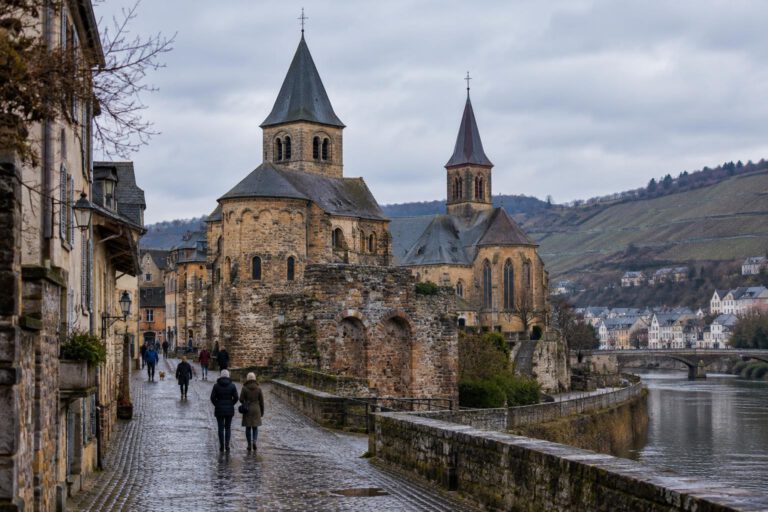
The cathedral, too, tells a story that goes beyond medieval piety. Its origins reach back to late antiquity; over the centuries, it was extended and altered. The neighbouring Church of Our Lady, an early Gothic building, is also part of the World Heritage site. Around it, you can see how Christian institutions developed within an urban space previously shaped by Roman rule.
UNESCO lists the Roman monuments, cathedral and Church of Our Lady under a single title. This is more than a convenient grouping for visitors: it draws attention to the site’s long history of use. Trier is therefore particularly rewarding for travellers who want to consider architecture, religious history and urban development together. It is less suited to a holiday devoted purely to nature or a packed programme of excursions outside the city.
A winter’s day in the city
The cathedral quarter is a sensible starting point. From there, it is a short walk through the city centre to the Basilica of Constantine and the Electoral Palace with its palace garden. The Rheinisches Landesmuseum adds archaeological finds and historical context to the walk. Church and museum opening hours vary; before visiting, check what is accessible on the day.
Those who want to see more than façades can set aside part of the day for a museum and spend the remaining time moving between squares, churches and ancient remains. The tourist information centre offers a guided walk in winter; dates and conditions may change. This makes the stay easy to plan even with fewer hours of daylight.
At a glance
- Best time to visit: Winter is also suitable for a culture-focused stay; museums and indoor attractions complement walks.
- Getting there: Regional trains connect Trier with Koblenz and Saarbrücken, among other places. The city bus network connects with trains and regional buses at the main railway station; check current connections before travelling.
- Highlights: Porta Nigra, Imperial Baths, Basilica of Constantine, Cathedral of St Peter, Church of Our Lady and Rheinisches Landesmuseum.
- Tip for a day: Combine the cathedral quarter and basilica with a museum visit; check opening hours in advance.
- Trier Tourismus und Marketing GmbH, trier-info.de.
Original reviewed by the editors · 11 November 2026