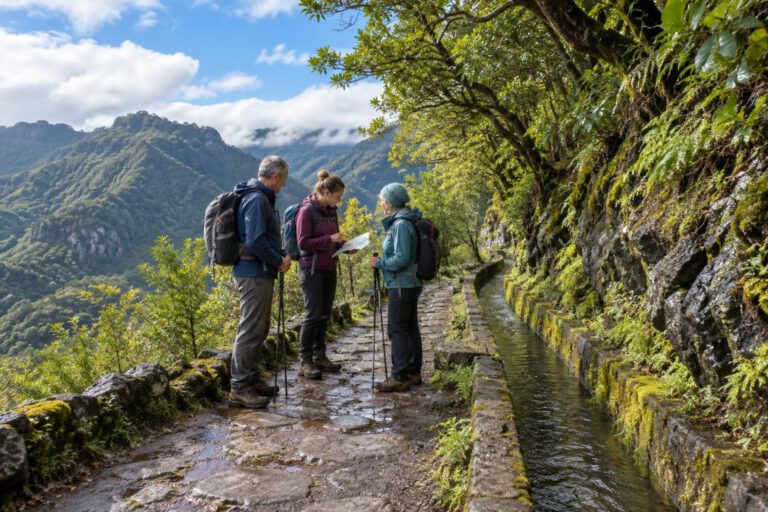
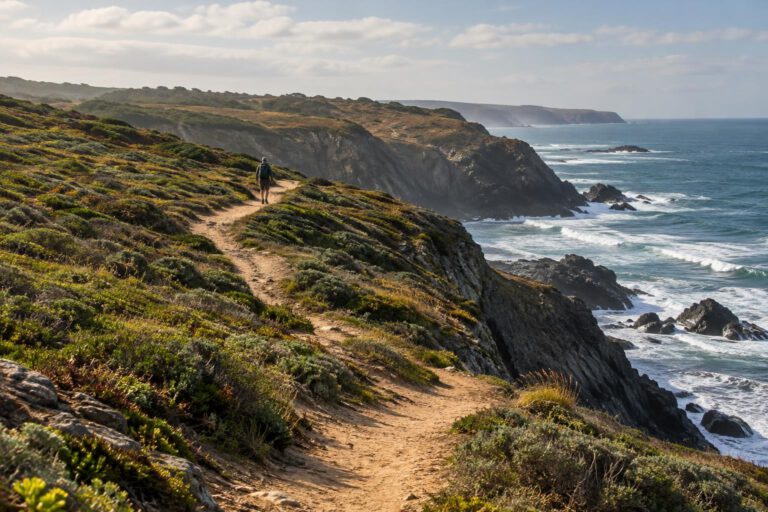
When the days grow short in Central Europe, the season for long walks begins on Santo Antão. This Cape Verdean island is not a destination for a week spent mainly on the beach: its character lies in rugged volcanic mountains, deeply carved valleys and paths linking villages and farmland. For those who want to walk and would rather give an island time than cram as many names as possible into an itinerary, it offers a good reason for a winter trip.
Santo Antão lies in the north-west of the archipelago. A mountain range divides the island; Porto Novo in the south is the arrival point, while Ribeira Grande is one of the main towns in the north. Portugal claimed the island in 1462, though according to the local tourism organisation it was not settled until later. Its history is also one of difficult connections: for a long time, the mountains were considered a formidable barrier between different parts of the island.
Between craters and cultivated landscapes
On Santo Antão, landscapes change over short distances. The uplands reveal volcanic formations and open, barren terrain; in valleys such as Paul, fields and orchards grow between steep slopes. The island’s tourism organisation lists several marked routes, including the “Route of the Valley” through the Cova and Paul area. This makes the island appealing to walkers who want not just to reach viewpoints, but also to appreciate the relationship between landscape and agriculture.
The contrast is part of the appeal: one walk might lead through cultivated valleys, another across high ground and along coastal paths. At the same time, this is not terrain to tackle with a packed daily checklist. Route choice, weather and the return journey need to be considered together. Those travelling without a hire car should coordinate accommodation and transfers in advance rather than assume that every starting point can be reached on the spur of the moment. For specific distances, walking times and a route’s current condition, the information provided by the trail operator is authoritative.
Winter suits walking
Cabo Verde Tourism names October to May as the best time for walking and trekking; it gives November to July as the dry season. On Santo Antão, this fits with many winter travellers’ holiday plans. It is no guarantee of consistent weather: conditions in the mountains can differ from those on the coast. Between December and February, the Harmattan can also bring dry dust haze and reduce visibility, as the country’s tourism organisation explains.
Santo Antão suits travellers who enjoy exploring on foot, are prepared for changes in elevation and do not need to move base every day. The island is less suitable for anyone seeking a week devoted entirely to beach holidays, a lively nightlife scene or excursions that can be planned to the minute. Even those staying only briefly should treat arrival and departure as separate stages of the trip.
Ferries rather than hurried island-hopping
The ferry route runs from Mindelo on São Vicente to Porto Novo. CV Interilhas lists the route in its timetables; Cabo Verde Tourism also describes ferry services between the two ports. The crossing is therefore a practical way to reach the island, but up-to-date timetables and departures should be checked before travelling. There is no rail connection on Santo Antão; when travelling from abroad, the journey must be planned around the flights and ferry crossings booked.
For a trip with few changes of base, it makes sense to choose accommodation as an initial base and organise day trips from there. Those wishing to explore several valleys can plan a second place to stay, provided transfers and luggage transport have been arranged. A generous time buffer is worthwhile: it leaves room for an extra day’s walking and helps avoid simply ticking off the island between two ferry departures.
At a glance
- Best time to visit: Cabo Verde Tourism recommends October to May for walking; according to the organisation, the dry season runs from November to July.
- Getting there: Ferry between Mindelo on São Vicente and Porto Novo on Santo Antão. Check current departure times. There is no railway on Santo Antão.
- Highlights: Volcanic uplands, the Paul valley, Cova and the island’s designated walking routes.
- Tip for a day out: Choose a route in the Cova and Paul area and arrange transfers and the return journey in advance.
- Visit Santo Antão, the local tourism organisation.
Original reviewed by the editors · 18 November 2026