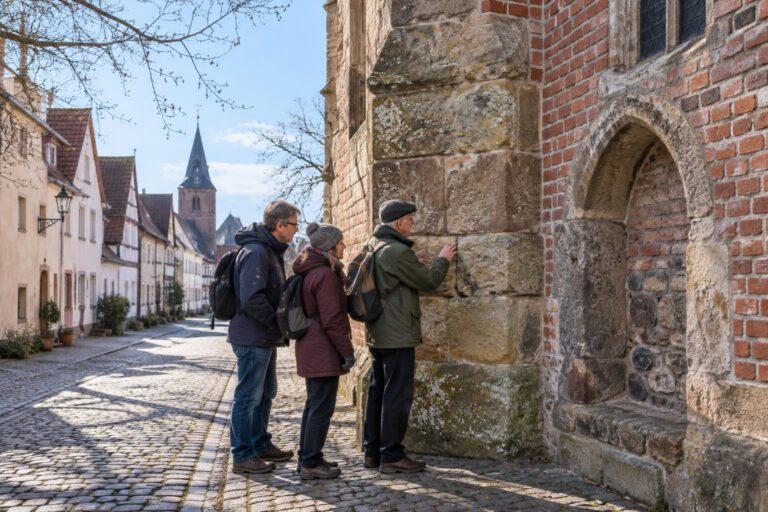
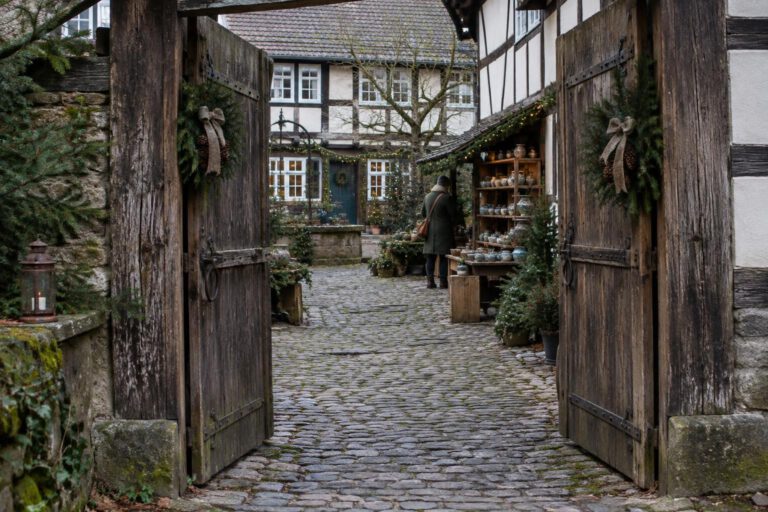
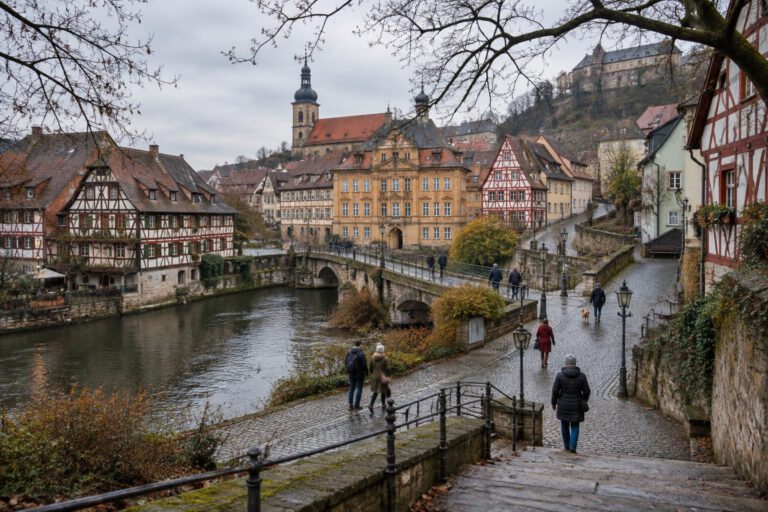
Quedlinburg’s half-timbered architecture can be read from the street: in its beams, its overhanging upper storeys and the narrow lanes that branch out between houses and squares. On the first three weekends of Advent, another layer is revealed. Historic courtyards open up, usually hidden behind gates in everyday life. Arts and crafts and seasonal food are on offer; the courtyards themselves show how the city’s buildings extend beyond its streets.
The UNESCO World Heritage site encompasses the collegiate church, castle and old town. It tells of power and faith on the Schlossberg, as well as trade, crafts and life in a city whose buildings have evolved over many centuries. Advent is a good occasion to explore these connections rather than limiting a visit to the market.
A city of many eras
Quedlinburg’s importance dates back to the Ottonian period. After the death of Henry I in 936, a religious foundation for women was established on the castle hill; the collegiate church of St. Servatii recalls the close connection between the city’s history and political power. In the Middle Ages, a merchants’ settlement developed below the Schlossberg. The granting of market rights in 994 strengthened trade. The old and new towns merged into a joint municipality in 1330.
This architectural heritage is far from a uniform stage set. According to the German Commission for UNESCO, more than 1,300 half-timbered houses spanning six centuries have survived. A particularly large number were built between 1620 and 1720, when Quedlinburg was flourishing economically. The Fachwerkmuseum im Ständerbau, a half-timbering museum housed in a building from the first half of the 14th century, explains the development of this construction method and its restoration. It reveals what a courtyard gate only partly gives away: half-timbering is at once a craft, a way of living and a record of changing economic circumstances.
Preserving the cityscape is also part of its more recent history. Numerous half-timbered houses fell into disrepair in East Germany; during the political upheaval at the end of the communist era, residents prevented planned large-scale demolitions in the north of the old town. Since the first renovation work in 1990, the buildings have been gradually repaired. The World Heritage site therefore owes its survival not only to its past, but also to ongoing care.
Advent as a starting point, not the whole itinerary
“Advent in den Höfen” (Advent in the Courtyards) takes place in 2026 on 28 and 29 November, 5 and 6 December, and 12 and 13 December. According to the organisers, the courtyards are open from 11am to 7pm on each day; the city’s general administrative order lists 24 participating courtyards. Dates and times are correct as of 18 November 2026; check the organiser’s latest information before travelling.
Crowds are part of the occasion. At the same time, visitors flow through narrow historic streets where everyday life, homes and event activities meet. The city has announced vehicle access restrictions for the weekends. Anyone walking between the courtyards is therefore passing through a living neighbourhood and should keep entrances clear and leave room for residents.
For a day visit, a sequence that takes in different perspectives works well: first the market square and lanes, then up to the Schlossberg and collegiate church, followed by a museum or a closer look at the architectural details of the old town’s houses. The courtyards can be woven into this exploration rather than defining the entire stay. This particularly suits travellers who enjoy discovering architecture and urban history slowly and on foot. Those primarily seeking peace and quiet or wishing to avoid larger crowds would be better choosing another date outside the Advent weekends.
At a glance
- Best time to visit: For Advent in den Höfen, the first three weekends of Advent; for a quieter walk around the city, choose a date outside the event.
- Getting there: Quedlinburg is accessible by regional train from the direction of Magdeburg and Halle; bus services are also available. For Advent, the tourism organisation recommends travelling by train or bus. Check the latest details of your particular connection for your day of travel.
- Highlights: The collegiate church of St. Servatii and the Schlossberg, the historic old town, half-timbered houses, the Fachwerkmuseum im Ständerbau and Advent in den Höfen.
- Tip for a day visit: Combine the old town and Schlossberg with a museum visit, planning stops at the open courtyards along the way.
- Quedlinburg-Tourismus, quiedlinburg-info.de.
Original reviewed by the editors · 18 November 2026