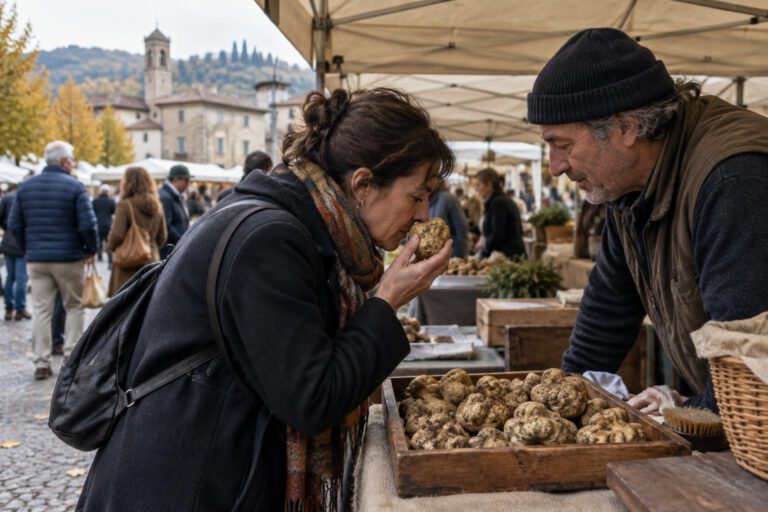
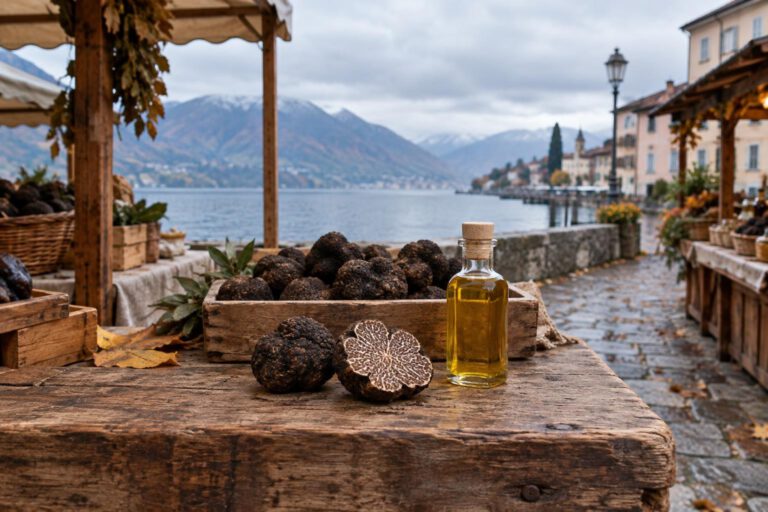
In the Mirna Valley, white truffles grow underground, hidden in the damp soil of the Motovun forests. In autumn, this rare fungus takes centre stage in Istrian cuisine. Those who try it fresh experience a seasonal product; those who take home a jar of Tartufata (truffle paste) bring back a preserved preparation with its own list of ingredients and distinctive flavour.
Istria’s tourist board identifies the Mirna Valley and Motovun Forest among the region’s truffle-growing areas. Here, specially trained dogs are used to search for the fungi growing underground. The area forms part of the so-called Istrian truffle triangle between Pazin, Buje and Buzet. This landscape is both a habitat and the foundation of a regional food economy: seasonal cuisine draws visitors, while processed products extend the truffle season into jars and kitchen cupboards.
The white truffle’s brief season
“White truffle” does not refer to a single product that is equally available everywhere. The Istria portal lists several species under this name. For the particularly prized Tuber magnatum, it gives a season running from 15 September to 31 January, with October considered the peak. The Croatian tourist board likewise describes the autumn season as lasting until roughly the end of the year. These time frames offer guidance, but guarantee neither a successful find nor any particular offering in the kitchen.
The difference is also apparent in the kitchen. According to the Istrian portal, white Tuber magnatum is eaten raw. Finely shaved, it is served over dishes such as Fuži, the typical Istrian pasta, or gnocchi. The warm food carries its aroma without subjecting the truffle to prolonged cooking. Black truffle species have different harvesting seasons, and some are cooked briefly. Visitors travelling in autumn can therefore ask about the species and origin rather than relying on colour alone.
What stays in the jar
Tartufata is a preserved truffle preparation, not a fresh truffle. The Croatian tourist board describes how truffles are also sliced and preserved in olive oil. For a paste or sauce, the ingredients depend on the individual product. A jar can bring the flavours of Istrian truffle cuisine into your home kitchen, but it does not simply reproduce the freshness of a seasonal truffle.
When buying, it is worth checking the ingredients list: which truffle species is listed, where does it appear, and is a percentage given? The European Commission explains that ingredients in prepacked foods must generally be listed in order of weight; specific mandatory information also covers storage conditions and shelf life. A prominent picture of a truffle alone does not tell you which species or how much is actually inside. If in doubt, ask to see the label or enquire about the exact ingredients.
A culinary journey with questions
In autumn, the search for truffles leads into a landscape of forest, river valley and small towns and villages in the Istrian hinterland. Alongside the season, practical questions also matter when planning a trip: are fresh truffles available that day? Which species is being served? Is the dish flavoured with fresh truffle or a truffle preparation? Check opening hours and seasonal closures before visiting.
At the table, you can taste the difference directly: freshly shaved over simple pasta or as an ingredient in a preserved paste. When choosing something to take home, the ingredients list, species and origin offer more guidance than a promise on the front of the jar. In this way, a truffle trip is about more than a purchase: it begins with a seasonal product in the Mirna Valley and continues at home with a different, processed flavour.
Original reviewed by the editors · 18 November 2026