Anyone planning a cycling holiday for 2027 over the winter often commits to more than a starting point and a destination: daily distances, overnight stops and travel to and from the route. It is precisely this structure that can become a burden in heat, heavy rain or when a route is closed. Preparing for the weather therefore starts before the first turn of the pedals – by asking how much flexibility your booking allows and what support a route actually offers.
What the ADFC figures show – and what they do not
The ADFC has added questions about climate adaptation to its cycle tourism survey. Of the cycle tourists who were away for at least three nights, 36 per cent said there were sufficient facilities offering protection against extreme weather – such as shelters, shaded resting places or shaded sections of the route. Information on protection against extreme weather had been noticed by 26 per cent. According to the ADFC, the survey comprised 17,314 usable questionnaires collected between October and mid-December 2025.
These figures describe what travellers noticed and felt was adequate. They do not amount to an inventory of all cycle routes. A water point may exist yet be missing from the map; advice may be available online without being visible along the route itself. Conversely, low awareness alone does not tell us whether infrastructure is lacking. This gap between provision and how easily it can be found is crucial to planning a trip.
The ADFC also compares travel behaviour with weather data: the number of cycling holidays tended to decline in years with high rainfall rather than in years with many hot days. This describes a correlation in the data analysed, not a weather forecast for 2027. Nor can it be taken to mean that heat poses no risk to individuals. Health, age, the route profile and personal fitness all affect what makes a daily stage manageable.
Build flexibility into your booking
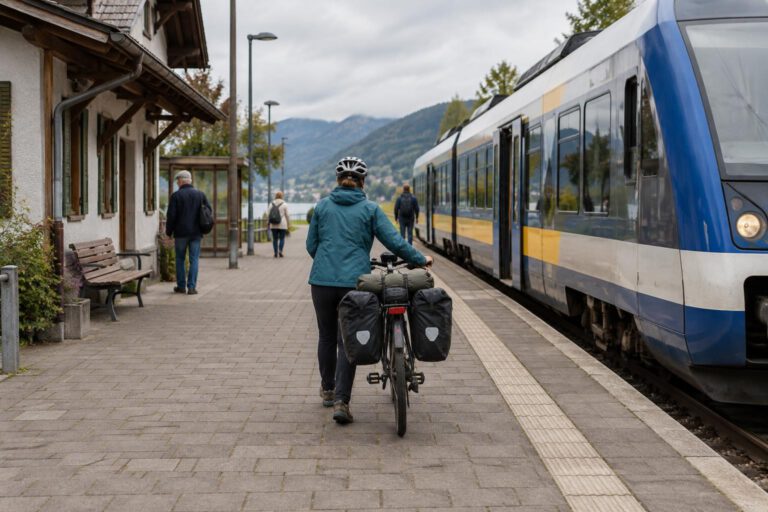
If you book several overnight stays in advance, you can plan the route so that a day’s ride can be shortened, moved or skipped. This starts with the accommodation’s terms: how late can you cancel or change your booking free of charge? Is it possible to arrive and depart at different locations? Are there railway stations or other transport connections along the route that accept bicycles? These connections vary by service, season and bicycle space availability; timetables and bicycle carriage conditions must be checked for your specific travel dates.
A shorter daily stage also creates options. In hot weather, a later start with a break in the shade may make sense; during thunderstorms or heavy rain, it may be safer to skip a stage. Weather warnings help with decisions at short notice, but are no substitute for local information about closures, flooding or damage. Planning should therefore include current notices from the route operator or tourism organisation alongside the route map.
Ask specific questions about protection
The fact that a cycle route exists does not mean that shade, drinking water or a safe shelter are available along its entire length. You can check this section by section: is there a map of drinking water points? Are they publicly accessible or subject to opening hours? Are closures and diversions reported promptly? Is an alternative route signposted – and does it follow a suitable path?
The RuhrtalRadweg (Ruhr Valley Cycle Route) is one example of clearly identified provision. Its tourism organisation lists more than 100 drinking fountains and refill stations along the route; some stations are subject to seasonal restrictions or opening hours. This example demonstrates what is available on this route, not the facilities on other long-distance cycle routes. It is worth checking the latest map and route notices before setting off.
Protection from heat and preparation for heavy rain are also responsibilities of regions and operators. The Federal Climate Adaptation Act identifies the protection of health, infrastructure and nature as adaptation objectives. For cycle tourists, this becomes tangible when information reaches them in an emergency, routes are repaired after damage and diversions are communicated reliably. Such measures require maintenance and coordination – not just a sign at the side of the route.
Weather planning is part of the route
Three checks are therefore useful when booking for 2027: which daily stage can be changed flexibly? What alternatives are available if a route closes or the weather turns? And what protection is actually documented along each section? The clearer the answers to these questions, the less the trip depends on having to ride exactly as planned every day.
For the ride itself, weather conditions, warnings and route updates remain crucial; they cannot be reliably predicted several months in advance. A robust plan does not promise ideal weather. It leaves room to respond to the weather as it is – while recognising that shade, water and safe alternatives cannot be taken for granted everywhere.
Original reviewed by the editors · 17 November 2026