You do not have to fly all the way to the tropics to escape the grey winter. In southern Europe, you can spend longer outdoors: a walk by the sea, lunch on a sunny terrace, a visit to a historic old town. How much warmth you actually find, however, depends heavily on the island, coastline, altitude and weather. The “south” is not a single climate zone.
The Canary Islands are the most reliable choice for mild winter days. Those who prefer to stay closer to mainland Europe while enjoying some culture will find a varied mix in Andalusia. The Algarve, meanwhile, suits travellers who would rather experience the Atlantic on foot than in a swimsuit.
Canaries: volcanic landscapes rather than winter downtime
The Canaries lie off the north-west African coast and offer plenty of opportunities to get outdoors even in winter. TURESPAÑA puts the archipelago’s average annual temperature at around 22 degrees; this figure describes the year as a whole and does not promise consistent warmth everywhere. AEMET gives a mean January temperature of 18.4 degrees for Tenerife South Airport. The figures come from the climate summary based on reference data for 1981–2010.
On Lanzarote, dark lava fields and reddish soils give the landscape its character. Tenerife combines coastline with volcanic highlands; on Gran Canaria, beaches and the mountainous interior lie close together. It is precisely these contrasts that make the Canaries appealing to active travellers: days can begin with a coastal walk and continue in a completely different landscape. Higher elevations are considerably cooler than the coast, so pack layers for walks.
The islands are well worth visiting for anyone seeking light, nature and exercise. Those who primarily want historic townscapes, museums and a mainland trip with short distances between stops are better off in Andalusia. And anyone expecting guaranteed swimming weather should not confuse winter with high summer.
Andalusia: cities between the coast and the Sierra Nevada
Andalusia is a winter destination for people who want to combine sunny hours with culture. Seville, Córdoba and Granada offer very different urban settings and layers of history; the Alhambra, the Mezquita-Catedral and Seville’s old town are among the region’s well-known attractions. Spain’s tourism organisation recommends Granada and the World Heritage cities of Úbeda and Baeza, among other destinations, for the cooler months.
On the coast, a trip can include walks by the sea, while inland, olive groves and mountain scenery shape the views. In the Sierra Nevada, winter can also mean snow. This is an appealing contrast, but no promise of consistently warm days: evenings turn chilly, and spells of rain are possible. Andalusia is particularly suited to a trip where good food, architecture and excursions matter more than a consistently summery beach atmosphere.
Algarve: Atlantic air and sweeping beaches
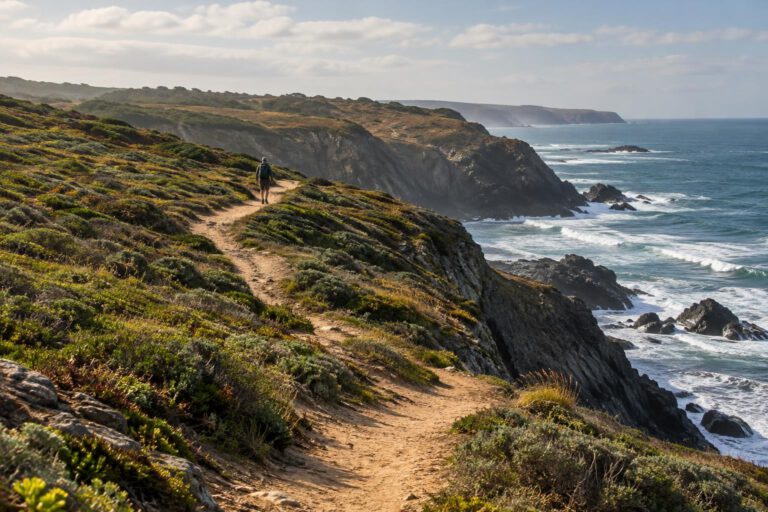
On Portugal’s southern coast, the Atlantic takes centre stage. In winter, the Algarve lends itself to long beach walks, small coastal towns and days filled with fresh air and wide-open spaces. Visit Portugal describes winter in the country as comparatively sunny; this is a general description for visitors, not a substitute for a local weather forecast. By the sea, wind and changeable weather can have a greater influence on how it feels than the temperature reading.
Anyone seeking peace and quiet on the beach in winter is more likely to find room to walk in the Algarve than reliable conditions for swimming. The region appeals to travellers who value a relaxed coastal trip with places that are easy to reach. For a combination of island scenery and more settled weather, the Canaries are the more obvious choice; for historic cities and varied inland landscapes, Andalusia offers more variety.
When best to travel
From December to February, the contrast with winter in central Europe is greatest, although the weather remains changeable even in the south. The shoulder seasons of autumn and spring are often more pleasant for extended sightseeing and walking; in high summer, the heat in Andalusia and the islands’ interiors can be taxing. Anyone deciding at short notice should check the specific weather outlook, local conditions and available transport connections before departure.
The choice therefore depends less on an abstract search for “sun” than on how you want to fill your days: volcanic trails and island-hopping in the Canaries, historic cities in Andalusia or the Atlantic coast in the Algarve. For a week with as many hours outdoors as possible and mild temperatures, the Canaries offer the strongest winter option. For culture and cuisine, Andalusia is the more compelling choice; for slow-paced days by the water, the Algarve.
Original reviewed by the editors · 17 November 2026