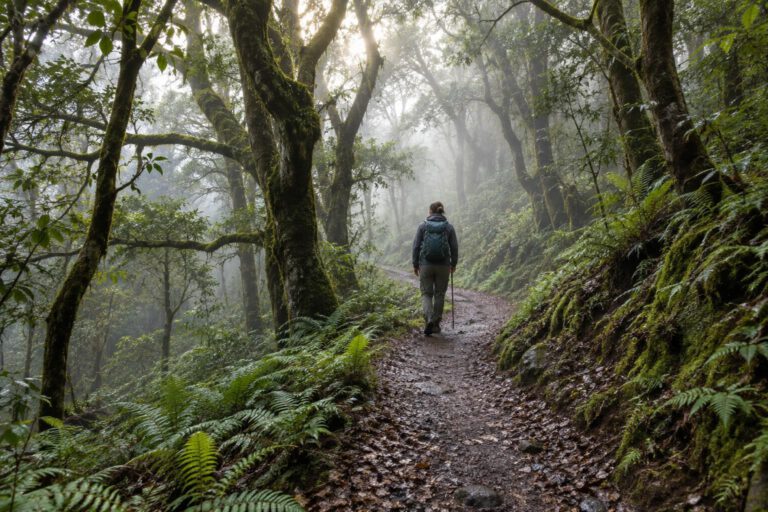
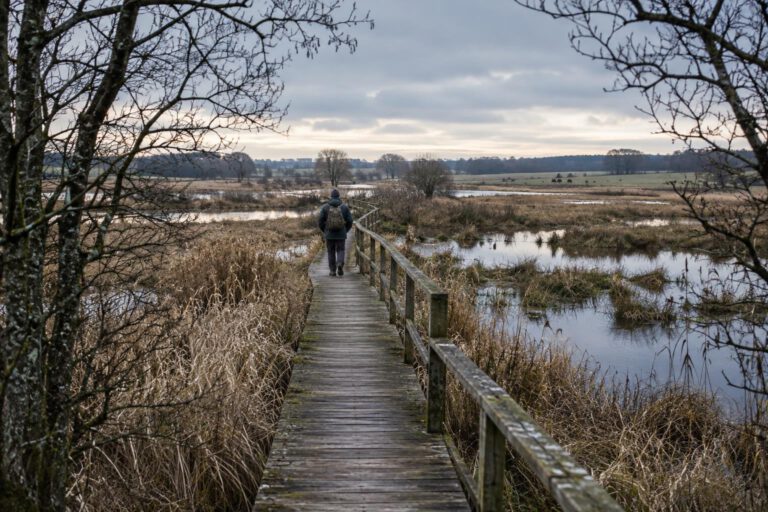
Between Villanueva de la Serena and Logrosán, the Vía Verde Vegas del Guadiana (Vegas del Guadiana Greenway) stretches for just under 58 kilometres through eastern Extremadura. The former railway line leads from the fertile plain across rivers and rice fields into a landscape of oak pastures and gently rolling hills. In winter, cranes arrive in the region from northern Europe. They turn the route into a journey for those who prefer to take their time and observe rather than tick off as many places as possible.
The railway line between Villanueva de la Serena and Talavera de la Reina was never completed. The section that was built now serves as a route for cyclists and walkers. Starting near Villanueva de la Serena railway station, it initially passes through agricultural land. Further on, the route crosses the Guadiana on high viaducts. Beyond them lie broad fields, irrigation channels and the rice fields of Palazuelo and Guadalperales, which lie within bird protection areas.
From the plain into the dehesa
The changing landscape is what truly defines this route. At first, the views are dominated by arable fields, orchards and the long, open horizons of the river plain. Further west and south, the landscape becomes hillier; oaks characterise the dehesa, the landscape of pasture and woodland where farming and nature intertwine. Old station buildings and goods sheds are reminders that the route was once intended for trains. In Logrosán, the trail ends at the former station; the local mines and a visitor centre tell the story of the area’s mining history.
For a winter trip, the section around the Vegas del Guadiana is particularly interesting: bird protection areas lie along the route, and cranes overwinter in the surrounding area. One designated observation point is the Dehesa de Moheda Alta near Navalvillar de Pela. The nature park there focuses, among other things, on cranes and the dehesa. Which animals appear depends on the season and conditions; keeping quiet and maintaining a respectful distance are part of watching them.
The route requires planning
Here, the name “Vía Verde” does not mean a fully developed, car-free cycle path throughout. The operator describes sections where the original trackbed is interrupted: here, the route follows tracks also used by vehicles. This is particularly important for families with children and anyone expecting a completely segregated route. Check the latest information on trail conditions before setting off.
Villanueva de la Serena railway station is close to the start of the route and has train services. Arriving by rail is therefore possible in principle. However, this does not automatically guarantee a suitable return journey from the other end or a reliable connection between any chosen sections. If travelling without a hire car, check train and bus connections for your specific travel dates, and do not plan a linear route as a round trip. The largely flat terrain makes the route appealing for leisurely cycling and longer walks; covering the full distance requires time, stamina and an organised return journey.
At a glance
- Best time to visit: Winter for the chance to see cranes; sightings depend on the season.
- Getting there: Take the train to Villanueva de la Serena; check timetables and your return journey in advance. A car-free round trip has not been confirmed.
- Highlights: The Guadiana viaducts, rice fields near Palazuelo and Guadalperales, dehesa and the Moheda Alta crane area.
- Tip for a day trip: Choose a section near Villanueva de la Serena and make the river crossing on the viaducts your destination; arrange your return route and transport in advance.
- Vías Verdes de España and Turismo de Extremadura.
Original reviewed by the editors · 13 November 2026